

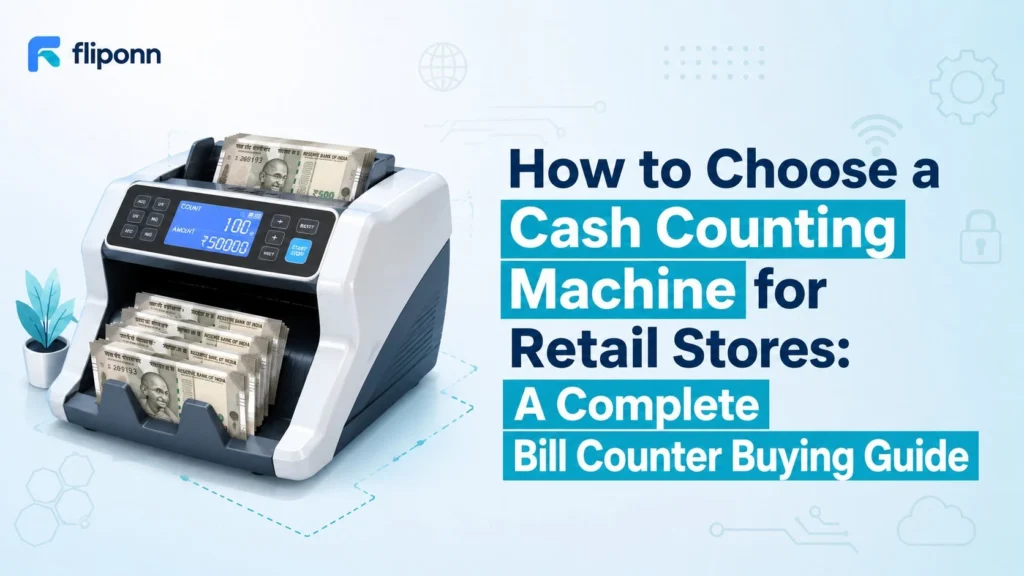
Running a retail store means handling cash every single day, sometimes thousands of dirhams across multiple transactions. If your team is still counting banknotes by hand, you are not just wasting time, you are also opening the door to costly errors and counterfeit currency slipping through undetected.
That is why investing in the right cash counting machine is one of the smartest operational decisions a retail business owner can make. But with so many models available from basic note counters to advanced multi-currency machines with UV MG IR detection, knowing exactly what to look for can feel overwhelming.
This bill counters buying guide walks you through every key consideration, so you can choose the right cash handling equipment with confidence and protect your business from day one.
1. Understand Your Cash Volume and Business Type
Before comparing specifications, start with your own operation. A busy supermarket processing hundreds of transactions an hour has very different requirements from a boutique retail shop handling a few dozen daily sales.
Ask yourself: How many cash passes through your till each day? Do you regularly handle mixed denominations? Do customers pay in foreign currencies?
Your answers determine whether you need a basic banknote counter, a machine with multi-denomination counting, or a full-featured currency counting machine that handles mixed bills and calculates totals automatically. If you are unsure whether your business actually needs one, this guide on why retailers need a cash counter breaks down the real operational and financial case clearly.
Matching the machine to your actual cash flow is the essential first step, buying more machine than you need wastes budget, while buying too little means you will outgrow it within months.
2. Prioritise Built-In Counterfeit Detection: UV, MG, and IR
Counterfeit currency is a genuine risk in retail, and one of the most important features to look for in any bill counter machine for business is a robust, multi-layered detection system. The three industry-standard methods are:
UV (Ultraviolet): Detects invisible security features embedded in authentic banknotes, features counterfeit notes cannot replicate accurately.
MG (Magnetic): Reads the magnetic ink used in genuine currency printing, which most counterfeits lack entirely.
IR (Infrared): Scans the density, pattern, and composition of the note to verify authenticity at a deeper level beyond surface appearance.
A quality UV MG IR bill counter performs all three checks simultaneously, giving your business a layered defence. To understand exactly how these detection mechanisms work inside the machine, this detailed explainer on how money counters work is worth reading before you buy. For retailers in the UAE handling both AED and foreign currencies, machines with triple-layer counterfeit detection sensors are strongly recommended by the UAE Central Bank as part of standard cash handling procedures.
Do not settle for a machine with only one type of detection. A cash check machine with triple-layer detection costs slightly more upfront, but a single counterfeit note accepted at your till can far exceed that price difference.
3. Counting Speed-Balance It Against Accuracy
Speed matters in retail, particularly during peak hours when queues form and pressure builds. Most quality bill counters process between 800 and 1,500 notes per minute. When working through your bill counter guide shortlist, always evaluate speed and accuracy together, a fast machine that miscounts is worse than a slower one that gets every note right.
For most small to mid-size retail operations, a machine counting at around 1,000 notes per minute strikes the right balance. High-volume environments such as supermarkets, petrol stations, or money exchange counters may need machines at the upper end of the speed range.
Always verify that the machine maintains its stated accuracy at its highest speed setting. Some lower-quality cash counter machines slow down considerably when denomination detection or counterfeit checking is active and when things go wrong, understanding your machine’s behaviour matters. Familiarising yourself with common note counting machine error codes before purchase helps you identify whether a machine is flagging a genuine fault or simply a jammed note.
4. Multi-Denomination and Mixed-Bill Counting
This is where many retailers make an expensive mistake, purchasing a basic machine that can only count a single denomination at a time.
If your team regularly handles cash drawers containing a mix of AED 5, 10, 20, 50, 100, 200, and 500 notes, you need a machine with multi-denomination counting capability. These machines count a mixed stack and return a total value automatically, eliminating the need to manually sort notes before counting and saving significant time during end-of-day reconciliation.
When researching how to select a money counting machine with this feature, look for models described as “value counting” or “mixed denomination” counters. This single feature can reduce your daily cash reconciliation time considerably in a busy retail environment. You can explore currency counting machines with value counting capabilities suited to retail use across the UAE.
5. Batch Counting Mode
Batch counting mode automatically pauses the machine after reaching a preset number of notes. Set it to 100, and it counts exactly 100 notes then stops, letting you band, bag, and move on before the next batch begins.
This feature is invaluable for retail stores preparing cash for banking, dividing tills between staff shifts, or organising counted notes into specific amounts for float management. When considering features to look for in a bill counter for a retail environment, batch counting mode belongs near the top of your list if your store handles significant daily cash volumes.
6. Hopper and Stacker Capacity
The hopper is the loading tray where notes are placed before counting; the stacker collects them after. Capacity matters far more than most buyers initially realise.
A machine with a small hopper, say 100 notes, requires constant reloading during a high-volume count, slowing your team down and defeating the purpose of automation. For retail use, look for machines with a hopper capacity of at least 200 to 300 notes. Premium models offer up to 500, which is ideal for supermarkets, convenience stores, or petrol forecourts with heavy cash flow.
A core rule from this cash counting machine guide: always size the hopper for your busiest period, not your average day. You want a machine that handles your worst-case scenario without interruption.
7. Display Clarity, Ease of Use, and Reporting
A currency counter is only as useful as the information it presents. Look for machines with a clear, large LCD or LED display visible from a natural standing position. Dual displays one facing the operator and one visible to the customer, are particularly effective at retail counters, as they add transparency and build customer confidence in your cash handling.
Some advanced machines connect to receipt printers or POS systems, enabling printed cash logs and audit reports. If your retail operation requires detailed financial records or operates under audit requirements, this connectivity is worth prioritising alongside accuracy in your money counting machine buying guide checklist.
8. Know the Common Problems Before You Buy
No machine is completely maintenance-free, and the best bill counter for business is one you can keep running reliably over time. Before settling on a model, it pays to understand what can go wrong.
Common issues include note jams from worn or folded currency, sensor errors from dust buildup, and miscounts caused by notes that are too damp or too worn to be read accurately. This guide to money counting machine problems covers the most frequent issues retailers face and how to prevent them, a genuinely useful read before you commit to a purchase.
Knowing the failure points of a machine in advance also tells you how easy it is to maintain and whether your team can handle basic troubleshooting without a service call.
9. Build Quality, Warranty, and After-Sales Service
Cash handling equipment takes a beating in a busy retail environment. Your banknote counter may run for hours every day, six or seven days a week. Choose a machine from a reputable brand or supplier offering a solid warranty, ideally 12 months or more with genuine local service support.
This is especially important when operating in the UAE. Sourcing your best bill counter for business from a local supplier means faster repairs, access to genuine spare parts, and technical support without international shipping delays. A machine with no local service network can bring your retail cash operation to a standstill if something goes wrong during a busy trading period.
Look for suppliers who provide on-site servicing, not just unit replacement. Fliponn Tech offers dedicated currency counting machine repair and servicing across Dubai and the UAE, with fast turnaround times for retail businesses.
10. Price vs. Total Value- How to Budget Smartly
The cheapest cash counter is rarely the best bill counter for small business. A low-cost machine with weak counterfeit detection could accept a fake note and cost you far more than the price saved. Equally, a top-specification model with features suited to a banking environment is simply wasted investment for a small retailer.
Use this framework when budgeting for your currency counter buying guide decision:
Entry-level (AED 300–700): Basic note counting, single denomination, limited detection. Suitable for very low-volume operations only.
Mid-range (AED 700–1,500): UV/MG/IR detection, multi-denomination support, batch counting. The right fit for most retail stores.
Premium (AED 1,500+): Mixed-bill value counting, high-speed processing, advanced sensors, print connectivity. Best suited to supermarkets, petrol stations, and money exchange businesses.
Most retail stores in the UAE will find the strongest value in the mid-range tier, feature-rich enough to handle real business demands, without over-investing in capabilities designed for banks or high-volume cash centres.
Quick Checklist Before You Buy
Run through these key points from this bill counter buying guide before making your final decision:
- Match hopper capacity and speed to your peak daily cash volume
- Insist on UV, MG, and IR counterfeit detection sensors as a minimum
- Confirm multi-denomination and mixed-bill counting if you handle varied notes
- Check for batch counting mode for banking prep and shift changeovers
- Review common error codes and maintenance requirements for your shortlisted models
- Buy from a supplier with a local UAE warranty and on-site service team
- Factor in display clarity and reporting capability for audit readiness
Final Thoughts
The right cash counting machine turns what is typically a slow, error-prone process into a reliable, fast, and secure part of your daily retail operation. Whether you are opening a new store or upgrading outdated equipment, this money counting machine buying guide gives you the framework to make a confident, well-informed purchase.
At Fliponn Tech, we supply and service a comprehensive range of professional-grade currency counting machines across Dubai and the UAE, from compact units for independent retailers to high-speed banknote counters for supermarkets and exchange businesses. Our team helps you identify the right machine for your specific operation, backed by full after-sales support and fast on-site servicing.
Ready to upgrade your cash handling? Visit Fliponn Tech today to find the best bill counter for your retail business.
Frequently Asked Questions
Which cash counter is good for small business?
For most small retail businesses in the UAE, a mid-range currency counting machine with UV, MG, and IR counterfeit detection is the best starting point. Look for a machine that handles multi-denomination counting, has a hopper capacity of at least 200 notes, and comes with local warranty support. You do not need a high-speed premium model — reliability and accurate counterfeit detection matter far more than raw speed at a small business scale. Browse Fliponn’s range of currency counting machines to find models suited to small and mid-size retail operations.
Is it legal to have a money counting machine?
Yes, it is completely legal for businesses to own and use a money counting machine in the UAE. In fact, the UAE Central Bank actively encourages businesses that handle cash to use electronic counting and detection devices as part of responsible cash management. There are no restrictions on purchasing or operating a cash counter for legitimate commercial use.
What features should a cash counter have?
At a minimum, a reliable cash counter machine for retail use should include UV, MG, and IR counterfeit detection, multi-denomination counting, batch counting mode, and a clear display. Beyond those essentials, look for an adequate hopper capacity for your daily volume, a low error rate on worn or folded notes, and easy access to local servicing.
How fast should a bill counter be for retail use?
For most retail stores, a bill counter processing between 800 and 1,000 notes per minute is more than sufficient. Where speed becomes critical is in high-volume environments like supermarkets, petrol stations, or busy convenience stores that reconcile large cash drawers multiple times a day. Keep in mind that speed should never come at the cost of accuracy — always confirm that your machine maintains its stated count rate when counterfeit detection and denomination identification are both active.
What is the difference between a note counter and a money counting machine?
A basic note counter simply counts the number of banknotes fed through it, regardless of denomination or value. A money counting machine, particularly a value-counting or multi-denomination model — goes further by identifying each note’s denomination and calculating the total monetary value of the stack automatically. For retail use, a money counting machine with value counting is almost always the better investment, as it eliminates manual denomination sorting and speeds up end-of-day cash reconciliation significantly.